
Turning around in the kitchen, stepping aside to let someone pass or changing direction while walking are movements most people make without thinking. However, with age, many older adults notice that these simple actions feel less steady or take more effort. Some begin turning in several small steps, while others feel briefly unbalanced when they pivot quickly. Understanding why this happens is the first step towards addressing it, and it also explains why mobility training for seniors often includes exercises focused on rotation and direction changes. Here are four common reasons turning can become more challenging over time.
1. Changes in the Balance Systems
Staying upright while turning depends on three main sources of information: the inner ear, vision and sensors in the muscles and joints that tell the brain where the body is in space. Turning places extra demands on all three at once, as the head, eyes and body move in different directions.
With age, these systems may become less sensitive. The inner ear’s balance organs can respond more slowly to movement, eyesight may change, and sensation in the feet can decrease. When the brain receives less precise information, quick turns may feel disorienting or unsteady.
2. Stiffness in the Hips, Spine and Ankles
Turning smoothly requires the hips, spine and ankles to rotate freely. Over time, joints can become stiffer due to reduced activity, wear and tear or conditions such as arthritis. When the upper and lower body cannot rotate independently, people often turn their whole body as a single block, taking several small steps instead of one fluid pivot. This “block turning” can make movements slower and recovery from a stumble harder.
3. Reduced Leg Strength and Power
Changing direction requires the legs to shift weight quickly from one foot to the other and push off in a new direction. Muscle strength and power tend to decline with age, especially in the hips and thighs. Weaker muscles may make it harder to take a quick corrective step when balance is disturbed.
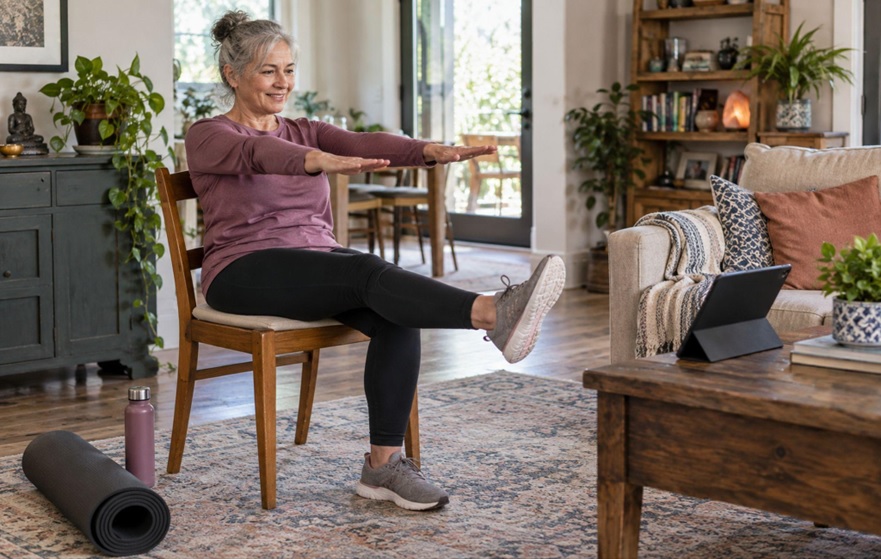
This is one reason balance training for seniors is often paired with strengthening exercises. Activities such as side steps, controlled weight shifts and sit-to-stand practice can help build the strength and control needed for safer turns.
4. Slower Reaction and Coordination
Turning involves planning the movement, coordinating several body parts and adjusting to the environment, all within a fraction of a second. Reaction times generally become slower with age, and turning while doing something else, such as talking or carrying an object, can be more demanding. This combination may make sudden direction changes feel less controlled. Practising turns while counting aloud or holding a light object, with supervision, can gradually build this skill.
Some medications can also affect alertness, coordination or blood pressure, which may contribute to unsteadiness during movement.
Making Turns Safer at Home
Several practical habits can reduce the risk of losing balance while turning. These include:
- Turning in a wide arc with small steps rather than pivoting sharply on one foot.
- Pausing briefly before changing direction, especially after standing up.
- Keeping walkways clear of clutter, loose rugs and trailing cords.
- Wearing supportive, well-fitting shoes with non-slip soles.
- Using handrails or sturdy furniture for support when needed.
- Switching on lights before moving through dim areas at night.
- Allowing extra time instead of rushing to answer the door or phone.
Anyone who experiences frequent dizziness, near falls or sudden changes in balance may benefit from a check-up with a doctor or physiotherapist, who can assess the specific causes and suggest suitable exercises.
Steadier Steps Ahead
Difficulty turning is common, but it is not something older adults simply have to accept. Many of the underlying changes, from stiffness to weaker leg muscles, respond well to regular, targeted exercise and small adjustments around the home, helping everyday movements feel more secure again.
Reach out to Vigeo to book a mobility and balance assessment with our trainers today.
